
Table of Contents
- Current Steel Market Overview for Contractors
- Steel Price Trends for Contractors in 2026
- Factors Driving Steel Market Volatility
- Steel Price Escalation Clauses for Construction Contracts
- How to Hedge Against Steel Price Increases
- Construction Material Cost Index 2026 Outlook
- Project Budgeting and Cost Estimation for Steel Materials
- Impact of Sustainability Regulations on Steel Costs
- Conclusion
Steel Price Trends for Contractors 2026: Market Guide
Last Updated: August 3, 2026
Current Steel Market Overview for Contractors
Steel price trends for contractors 2026 reflect a complex intersection of supply chain stabilization, persistent inflationary pressure, and shifting global demand patterns. At Steel & Pipe Supply, we track these movements closely because they directly impact your project margins and bottom line. Understanding where the market stands today, and where it’s headed, is essential for contractors planning budgets, locking in pricing, and protecting profitability on fixed-price contracts.
The structural steel market enters 2026 in a state of measured volatility. Unlike the dramatic swings of 2023-2024, current pricing has settled into a more predictable range, though unexpected disruptions remain a real risk. Mill lead times have compressed for standard products, giving contractors more flexibility in procurement timing. However, specialty grades and large volume orders still face extended delivery windows that can stretch budgets and timelines.
What most contractors miss is that steel price volatility isn’t random, it follows patterns tied to specific drivers. Raw material costs, global trade policies, domestic production capacity, and construction demand all play measurable roles. Recognizing these relationships helps you anticipate price shifts before they hit your invoice.
According to U.S. Geological Survey commodity price data, steel market conditions in 2026 show relative stability compared to the prior two years, though regional variations persist. This stability creates an opportunity: contractors who understand current market dynamics can negotiate better terms with suppliers and build more accurate cost escalation clauses into their bids.
Steel Price Trends for Contractors in 2026
Hot-Rolled Coil and Structural Steel Pricing
Hot-rolled coil (HRC) pricing remains the benchmark for understanding broader steel market movement. This is the foundational product from which many fabricated items derive, so HRC price trends typically signal what’s coming for structural steel, pipe, and plate products.
Current HRC pricing reflects a balance between domestic mill output and import competition. Domestic producers have maintained relatively steady production levels, which has kept prices from spiking. However, global demand fluctuations, particularly from Asia-Pacific construction markets, continue to exert upward pressure on commodity pricing.
Structural steel pricing for 2026 follows HRC trends closely, with additional premiums based on specific grades and fabrication complexity. Wide-flange beams, angles, and channels all track commodity pricing but may carry localized premiums depending on regional mill capacity and transportation costs. Contractors working on commercial construction projects should expect structural steel costs to remain elevated compared to pre-2022 levels, though price acceleration appears to have plateaued.
The real opportunity lies in timing. Mills typically offer better pricing during periods of lower order volume. Contractors who can schedule material purchases during slower construction seasons, typically late fall through early spring, often secure discounts compared to peak-season pricing.
Call multiple suppliers for the same specification and lock in pricing quotes for 30-60 days. Most suppliers will honor a written quote for at least 30 days, giving you a window to finalize your bid without absorbing unexpected price increases.
Cold Rolled Steel and Coated Steel Trends
Cold-rolled steel carries a premium over hot-rolled due to additional processing costs and tighter dimensional tolerances. For contractors using cold-rolled products, common in precision fabrication, HVAC ducting, and architectural panels, expect pricing to remain 15-25% higher than HRC equivalents.
Coated steel products (galvanized, painted, or powder-coated) add further cost layers tied to coating material prices and application labor. Zinc pricing, which drives galvanizing costs, has shown moderate volatility in 2026. Contractors specifying galvanized steel for corrosion resistance in coastal or high-moisture environments should budget for coating premiums and confirm availability before finalizing project timelines.
Paint and powder-coat pricing remains relatively stable, though specialty finishes, marine-grade epoxy, fire-rated coatings, or custom colors, can add 10-20% to base steel costs. Lead times for coated products typically extend 2-4 weeks beyond bare steel delivery, making early procurement essential for projects with tight schedules.
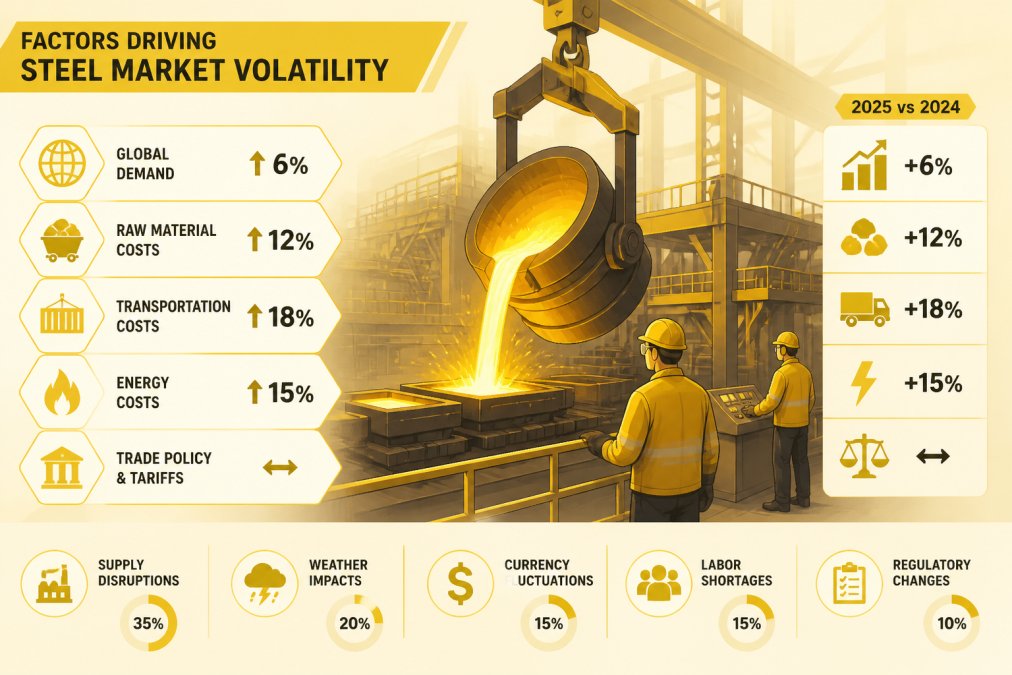
Factors Driving Steel Market Volatility
Supply Chain Disruption and Mill Lead Times
Mill lead times have normalized considerably from the 18-24 week delays seen in 2023. Standard structural shapes now typically deliver in 4-8 weeks from order placement, depending on mill capacity and order size. However, this improvement masks significant regional variation.
Domestic mills operate at moderate use rates. When demand spikes, triggered by major infrastructure projects or seasonal construction surges, mills quickly become capacity-constrained, and lead times extend rapidly. Conversely, slower demand periods create opportunities for negotiation and faster delivery.
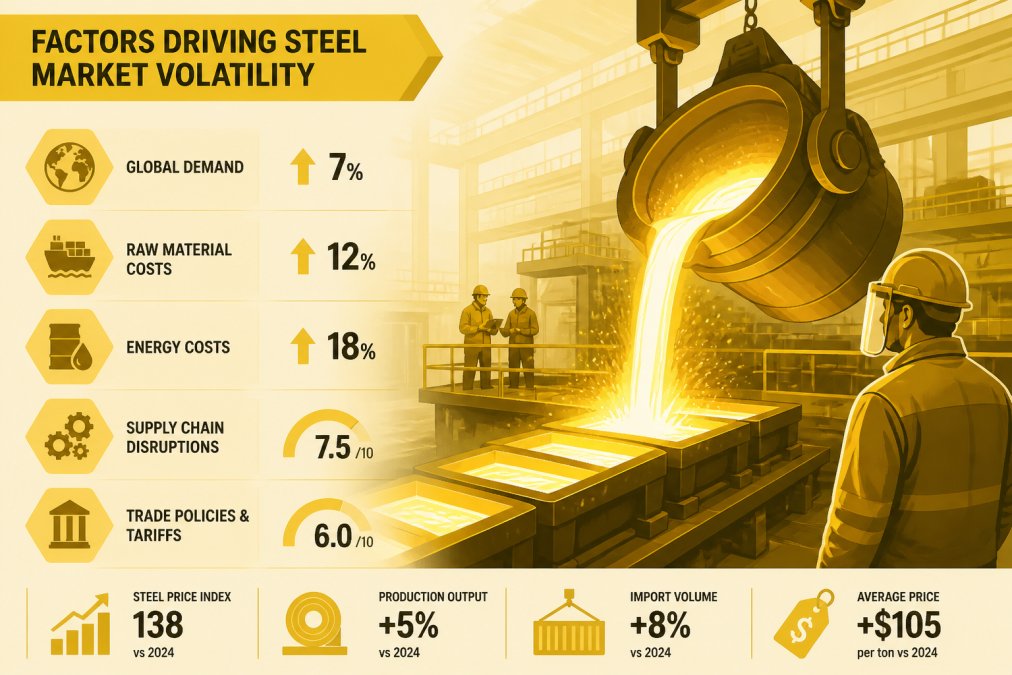
International shipping remains a constraint for imported steel products. Ocean freight rates have stabilized but remain elevated compared to pre-pandemic levels. Contractors importing specialty grades or large volumes should factor in 6-10 week lead times and plan accordingly.
The most critical variable contractors control is order timing. Placing orders during periods of lower mill use, typically mid-summer or post-holiday periods, secures shorter lead times and better pricing. Bundling multiple projects into single orders also improves lead time and pricing use.
Waiting until two weeks before material delivery to place your order is a recipe for delays and cost overruns. Mills prioritize orders placed 8+ weeks in advance. Plan your material procurement timeline backward from project start dates, not forward from when you think you’ll need it.
Global Trade Policies and Import Tariffs
Trade policy remains a significant wildcard for steel pricing in 2026. Tariff rates on imported steel products have stabilized at moderate levels, but the threat of policy changes creates pricing uncertainty. Contractors should monitor U.S. International Trade Commission trade data for any announcements regarding steel tariff modifications.
Import tariffs effectively create a price floor for domestic steel by making foreign competitors less price-competitive. This protects domestic mills from extreme price competition but also limits downside pricing pressure when demand softens. For contractors, this means steel prices are unlikely to fall dramatically even in a weak market.
Global trade tensions, particularly around steel from Asia, continue to influence U.S. domestic pricing. Domestic mills benefit from tariff protection, which reduces their incentive to lower prices aggressively. Understanding this dynamic helps contractors set realistic price expectations and negotiate from an informed position.
Domestic production capacity remains the real constraint. U.S. mills operate at roughly 75-80% use in 2026, leaving room to increase output without major capital investment. However, mills have shown reluctance to significantly expand capacity given market uncertainty, meaning supply constraints will likely persist.
Raw Material Costs and Inflationary Pressure
Raw material costs, primarily iron ore and scrap steel, remain elevated compared to pre-2022 levels. Iron ore pricing has stabilized but continues to fluctuate based on global demand, particularly from China. Scrap steel pricing, which influences electric arc furnace (EAF) mills, shows more volatility tied to industrial production cycles.
Inflationary pressure persists in labor, energy, and transportation costs. Mills pass these costs forward to customers, creating a floor below which prices cannot fall without eroding profitability. For contractors, this means expecting steel pricing to remain at or above 2025 levels throughout 2026, with potential for modest increases during periods of strong demand.
Energy costs, particularly natural gas for mill operations, influence production costs. Natural gas prices have moderated from 2022 peaks but remain volatile. Any significant energy price spike would likely trigger steel price increases within 4-6 weeks.
Steel Price Escalation Clauses for Construction Contracts
Fixed-Price Contracts vs. Cost Adjustment Models
The choice between fixed-price and cost-adjustment contract structures directly determines who bears the risk of steel price volatility. This decision should be made deliberately based on project scope, timeline, and market conditions.
Fixed-price contracts lock in material costs for the entire project duration. This approach protects your margin if prices rise but exposes you to losses if prices fall. For short-duration projects (under 6 months) or projects with clearly defined scopes, fixed-price contracts minimize risk and provide budget certainty for clients.
Cost-adjustment models tie material costs to published price indices, allowing contractors to pass through price increases (and decreases) to clients. This approach shifts price risk to the client but requires transparent documentation and monthly reconciliation. Cost-adjustment clauses work best for longer projects (12+ months) where price uncertainty is significant.
A hybrid approach combines a fixed-price base with a narrow escalation band. For example: "Material costs are fixed within a ±5% band of the bid price. Any increase or decrease beyond this band is split 50/50 between contractor and client." This approach shares risk while protecting both parties from extreme volatility.
The key is clarity. Vague escalation language creates disputes when prices move. Specific clauses tied to published indices, such as the American Iron and Steel Institute price index, eliminate ambiguity and reduce conflict.
Lock in steel pricing before signing the contract. Get written quotes from suppliers for the exact materials and quantities your project requires, then use those quotes to inform your bid and escalation clause language. Never bid on steel materials without current supplier pricing in hand.
Protecting Your Margins with Escalation Language
Effective escalation clauses require specific, measurable language tied to published indices. Vague references to "market prices" or "prevailing rates" create disputes and expose you to liability.
Strong escalation language includes:
- Reference index (e.g., "American Iron and Steel Institute Hot-Rolled Coil Index")
- Baseline price (the price at bid date)
- Adjustment trigger (e.g., "adjustments apply only to increases exceeding 5%")
- Calculation method (e.g., "monthly reconciliation based on published index")
- Cap or collar (optional limits on total adjustment)
- Timing (e.g., "adjustments apply 60 days after index publication")
Example clause: "Material costs for structural steel are based on the AISI HRC index price as of [bid date]. For projects exceeding six months, monthly reconciliation applies. Adjustments are limited to index changes exceeding ±5%. Contractor absorbs the first 5% of any increase; client absorbs increases beyond 5%. Index price is published by the American Iron and Steel Institute on the first business day of each month."
This language is specific, measurable, and reduces ambiguity. It also demonstrates professionalism and market knowledge to clients, which often justifies slightly higher bids.
How to Hedge Against Steel Price Increases
Contractor Procurement Strategies
Strategic procurement begins with demand forecasting. Know exactly what materials you need, when you need them, and in what quantities. Vague material lists create procurement delays and force you to buy at spot prices rather than negotiated rates.
Consolidate purchases across multiple projects when possible. A single large order for structural steel across three projects gives you significantly more negotiating use than three separate small orders. Many suppliers offer volume discounts of 5-10% for orders exceeding certain thresholds.
Develop relationships with 2-3 primary suppliers. Loyalty creates use. Suppliers are more willing to negotiate pricing, extend payment terms, and prioritize delivery for contractors who consistently bring them business. Steel & Pipe Supply helps contractors across Tampa Bay and beyond maximize margins by offering competitive pricing on high-volume purchases and maintaining flexible delivery schedules.
Timing your purchases strategically compounds savings. Ordering materials during slower construction seasons, typically November through February, secures better pricing and shorter lead times. Conversely, ordering during peak season (April-September) often means accepting higher prices and longer waits.
Inventory Management and Timing
Carrying inventory ties up capital but can protect you from price spikes if managed strategically. For frequently used standard items, angles, channels, pipe in common sizes, maintaining 4-8 weeks of inventory at average usage rates provides a buffer against price increases and supply disruptions.
The key is balancing inventory carrying costs against protection value. For a contractor spending $50,000 monthly on steel, carrying 6 weeks of inventory ($75,000 in materials) costs roughly $1,500-2,000 per month in financing and storage. If that inventory protects against a 10% price spike (which would cost $5,000 monthly), the inventory hedge pays for itself quickly.
Inventory works best for commodity items with stable demand. Specialty materials or products with uncertain demand create carrying costs without protection value. Use inventory strategically for your core materials, not as a catch-all.
Locking in Pricing with Suppliers
Written price quotes are your primary tool for locking in costs. Most suppliers will honor a written quote for 30-60 days, sometimes longer for major projects. Always get quotes in writing with clear expiration dates and specifications.
For longer projects, negotiate forward contracts that lock in pricing for future deliveries. A forward contract might specify: "Contractor may purchase up to 100 tons of structural steel per month for 12 months at the price quoted as of [date], with delivery within 6 weeks of order." This approach protects against future price increases while maintaining flexibility in timing.
Blanket purchase orders establish pricing for a defined period and quantity. These work well for ongoing projects where material needs are relatively predictable. A blanket order might specify: "100 tons of hot-rolled coil, delivered in 10-ton increments, at the quoted price, through [date]." This gives you price certainty and delivery flexibility.
Construction Material Cost Index 2026 Outlook
Price Index Trends and Economic Forecast
Published price indices provide transparency into market direction and support objective escalation clause discussions. The American Iron and Steel Institute publishes weekly pricing data for major steel products, including hot-rolled coil, cold-rolled sheet, and galvanized products.
Indices typically lag actual market prices by 1-2 weeks, so they reflect recent history rather than current spot pricing. However, they provide a consistent baseline for escalation clauses and help contractors understand directional trends.
For 2026, economic forecasts suggest moderate construction demand, which should keep steel prices relatively stable. However, any significant shift in infrastructure spending or commercial construction activity could quickly change this outlook. Contractors should monitor U.S. Census Bureau construction spending data for early signals of demand changes.
Regional variation matters. Steel prices in Tampa Bay and surrounding areas may differ from national averages due to transportation costs and regional mill capacity. Local suppliers like Steel & Pipe Supply often offer better pricing than national distributors because they eliminate unnecessary middlemen and optimize logistics.
Domestic Production and Market Intelligence
U.S. domestic steel mills operate at moderate capacity use, which provides some pricing stability but limits aggressive discounting. Major domestic producers include U.S. Steel, Nucor, and Cleveland-Cliffs, which collectively control roughly 60% of domestic flat-rolled steel production.
Mills typically announce price increases or decreases on the first business day of each month. These announcements signal market direction and influence spot pricing. Contractors should monitor mill announcements as a leading indicator of price trends.
Import competition remains muted due to tariff protection. Foreign steel, even with tariffs, remains price-competitive in some segments, but the tariff structure effectively maintains a price floor. This dynamic protects domestic mills but also limits downside pricing risk for contractors.
Project Budgeting and Cost Estimation for Steel Materials
Building Cost Escalation into Your Estimates
Accurate cost estimation requires understanding your specific material requirements and current market pricing. Generic estimates based on "typical" steel costs often miss the mark because they ignore project-specific factors.
Start with a detailed material takeoff (MTO). Specify exact grades, sizes, and quantities for every steel item in your project. Vague specifications like "structural steel as required" force suppliers to estimate, which they’ll do conservatively (expensively) to protect themselves.
Get current pricing from suppliers before finalizing your estimate. Don’t rely on pricing from six months ago. Steel prices change monthly, and using outdated pricing creates budget errors that compound across large projects.
Build escalation contingency into your estimate. For projects lasting 12+ months, add 3-5% escalation contingency to account for likely price increases. For shorter projects, 0-2% is typically sufficient. This contingency protects your margin if prices rise faster than anticipated.
Document your pricing assumptions in the estimate. Note the date of supplier quotes, the specific index used for escalation calculations, and any material price adjustments. This documentation protects you if disputes arise later.
Bid Management When Prices Shift
Price shifts between bid date and project start create challenges. If prices rise significantly, your bid margin erodes. If prices fall, you may have overbid and lost the project unnecessarily.
Manage this risk by limiting the time between bid and contract execution. Request decision timelines of 5-7 days rather than 30 days. Shorter decision windows reduce the probability of significant price movement.
If prices shift materially between bid and execution, communicate proactively with the client. Explain the shift, show the supporting data from supplier quotes and published indices, and discuss options: adjust the contract price, modify the scope, or extend the timeline to capture better pricing.
For projects with long bid-to-execution windows, include a price adjustment clause in your bid. For example: "This bid is valid through [date]. If execution occurs after [date], material pricing will be re-quoted based on current market conditions." This protects you from being locked into outdated pricing.
Impact of Sustainability Regulations on Steel Costs
Sustainability regulations increasingly influence steel costs through emissions pricing, recycled content requirements, and supply chain transparency mandates. Understanding these impacts helps contractors anticipate future cost pressures.
Electric arc furnace (EAF) mills, which produce steel from recycled scrap, have lower carbon emissions than traditional blast furnaces. Some jurisdictions offer incentives for using EAF steel, while others impose carbon pricing that makes EAF steel more attractive economically. This regulatory shift gradually increases demand for recycled steel, which influences pricing across the market.
Recycled content requirements in some building codes and green building certifications drive demand for scrap-based steel. Contractors specifying materials for LEED or similar certified projects should confirm that their steel suppliers track and document recycled content percentages.
Supply chain transparency requirements, particularly around conflict minerals and labor practices, add administrative costs to steel procurement. These costs are typically modest but accumulate across large material purchases. Suppliers who can document their supply chains transparently often command modest premiums.
For most contractors, sustainability regulations create incremental cost pressure rather than dramatic shifts. However, projects with aggressive sustainability targets may face material cost increases of 5-10% as suppliers invest in lower-carbon production methods.
Steel price trends for contractors 2026 reflect a market in transition, more stable than recent years but still subject to significant volatility. The contractors who manage costs most effectively are those who understand market drivers, lock in pricing strategically, and build clear escalation language into their contracts. Steel & Pipe Supply helps contractors across Tampa Bay navigate this complexity by offering competitive pricing on high-volume purchases, maintaining flexible delivery schedules, and providing market intelligence that informs better bidding and procurement decisions. Get started with Steel & Pipe Supply and secure the material cost certainty your projects require. Call for a FREE Quote!
Frequently Asked Questions
What are the main factors driving steel price trends for contractors in 2026?
Steel price volatility stems from supply chain disruption, global trade policies including import tariffs, raw material costs, and shifts in domestic production capacity. Inflationary pressure and mill lead times also affect pricing. Contractors should monitor commodity pricing indices and maintain relationships with suppliers who provide market intelligence to anticipate cost escalation.
How can contractors hedge against steel price increases when bidding projects?
Use escalation clauses in your contracts that tie price adjustments to a published steel price index. Lock in pricing with suppliers for specific delivery dates when possible. Consider increasing inventory during price dips if cash flow allows. Build contingency percentages into bids for projects with long lead times. Fixed-price contracts require higher markups to offset risk; cost-adjustment models protect margins better in volatile markets.
What is the construction material cost index outlook for 2026?
The construction material cost index depends on domestic steel production levels, global demand, and trade policy stability. While specific forecasts vary, contractors should expect continued volatility rather than sharp declines. Monitor published indices monthly and adjust project estimates accordingly. Market intelligence from local suppliers like Steel & Pipe Supply helps you anticipate regional price shifts before they impact your bids.
How do I protect my profit margins when steel prices spike between bid and delivery?
Include steel price escalation clauses in all contracts that reference a specific price index with clear adjustment triggers. Negotiate fixed-price commitments with suppliers for materials needed within 30-60 days. For longer projects, use cost-adjustment models rather than fixed pricing. Build realistic contingencies into estimates based on historical volatility. Work with suppliers who offer transparent pricing and can guarantee lead times on standard inventory items.
This article was written using GrandRanker