Table of Contents
- Why Steel Pipe Dominates Construction Projects
- Structural Integrity and Load-Bearing Capacity
- Carbon Steel vs Stainless Steel Pipe: Choosing the Right Material
- Corrosion Resistance and Long-Term Durability
- ASTM Standards for Construction Steel Pipe: Meeting Code Requirements
- Cost-Effectiveness and Value Over the Project Lifecycle
- Maintenance Requirements for Steel Piping Systems
- Versatility Across Construction Applications
- Environmental Impact and Sustainability
- Conclusion: Steel Pipe as Your Construction Foundation
Last Updated: August 6, 2026
Why Steel Pipe Dominates Construction Projects
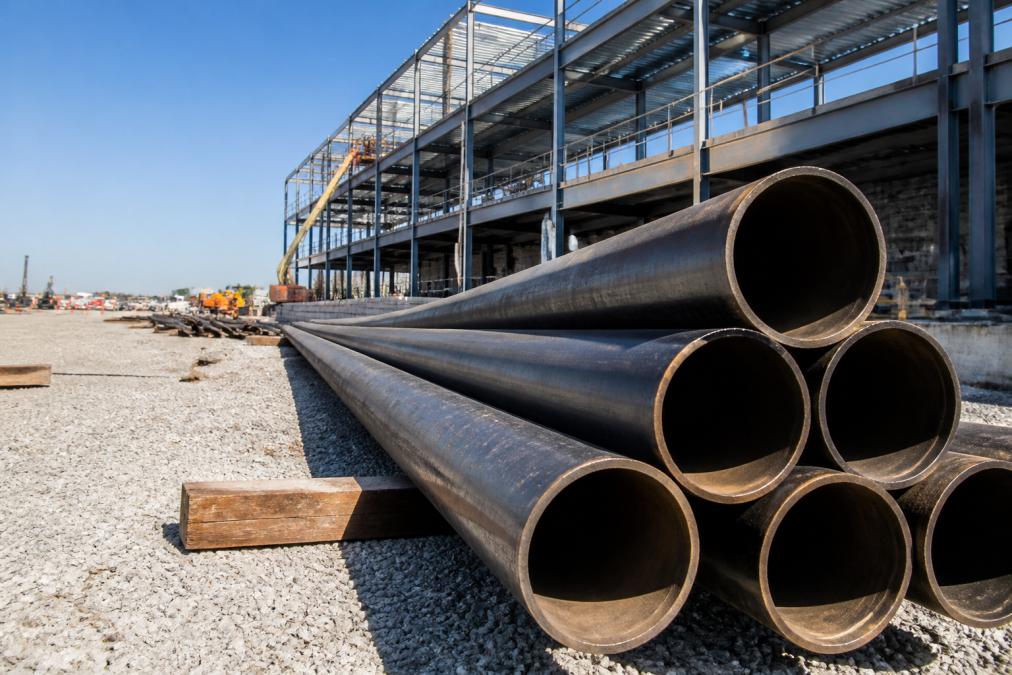
Steel pipe has become the backbone of modern construction because it delivers reliable performance within budget constraints. When managing commercial projects in the Tampa Bay area or civil infrastructure work across Florida, material choices directly impact your timeline, budget, and long-term performance. Steel pipe combines structural reliability with cost predictability in ways few alternatives match, performing consistently across temperature extremes and load variations.
This guide covers practical advantages that show up in inspection reports, maintenance schedules, and your bottom line, not marketing claims.
Structural Integrity and Load-Bearing Capacity
Steel pipe delivers exceptional structural integrity through its fundamental material properties. The tensile strength of steel allows it to carry heavy loads across long spans without deflection or permanent deformation, making it the default choice for load-bearing applications in commercial construction.
Most construction-grade steel maintains yield strength between 36,000 and 50,000 PSI depending on grade, giving designers a predictable performance envelope. This consistency enables confident load-path calculations without excessive safety margins that inflate material costs.
Steel’s ductility is equally important. Unlike brittle materials that fail suddenly, steel deforms gradually under excessive load, providing warning signs before catastrophic failure. When a connection reaches its limit, the steel bends rather than snaps, allowing load redistribution and emergency intervention.
Seamless steel pipe offers additional advantages for high-pressure applications. The manufacturing process eliminates the seam weld, typically the weakest point in welded pipe. For applications like well casing or directional drilling where pressure consistency matters, seamless construction provides superior reliability.
Carbon Steel vs Stainless Steel Pipe: Choosing the Right Material
The choice between carbon steel and stainless steel fundamentally changes project economics and long-term performance. Carbon steel dominates construction applications because it delivers structural performance at a fraction of the cost of stainless alternatives.
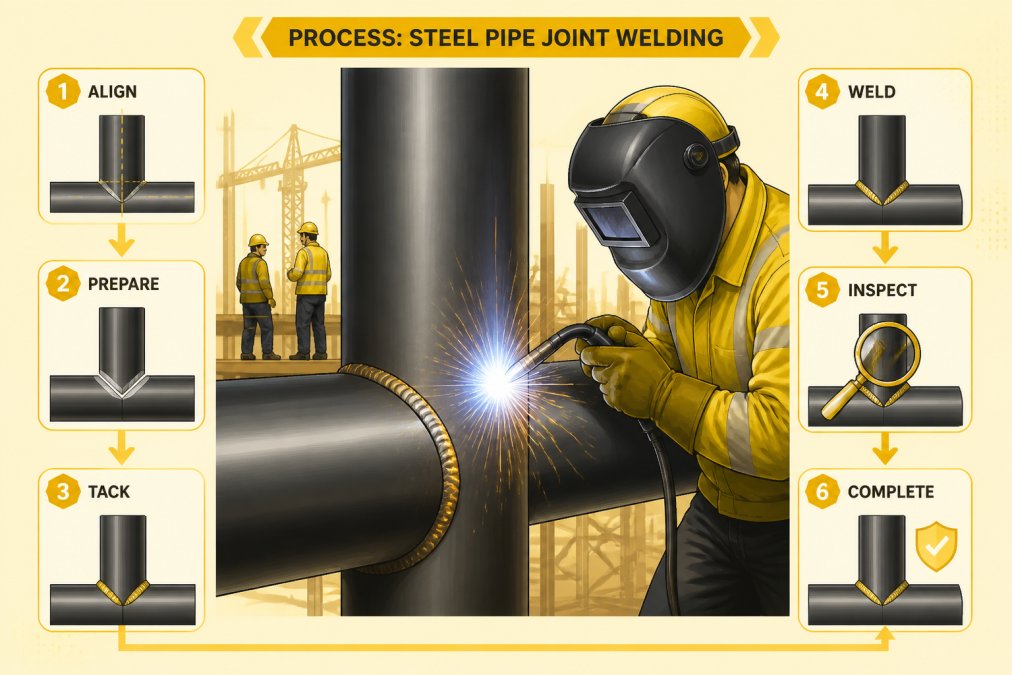
Carbon steel pipe offers superior weldability and fabrication speed. Welders process connections faster, reducing labor hours and keeping schedules on track. The material responds predictably to heat treatment and fabrication, which matters when working with tight delivery timelines typical in commercial construction.
Stainless steel enters the equation when corrosion resistance becomes the limiting factor. In coastal environments like Tampa Bay, where salt spray and high humidity accelerate oxidation, stainless steel maintains surface integrity indefinitely. The chromium content creates a passive oxide layer that self-repairs when scratched.
The cost difference is substantial. Stainless steel typically costs 3-5 times more than carbon steel for equivalent dimensions. For buried drainage systems or internal structural applications where corrosion risk is low, that premium cannot be justified. For exposed piping in high-humidity areas or applications involving chemical contact, the investment pays for itself through reduced maintenance and extended service life.
Corrosion Resistance and Long-Term Durability
Corrosion resistance determines whether your piping system survives decades with minimal intervention or requires constant maintenance.
Carbon steel in unprotected form oxidizes rapidly in moist environments. Galvanization, a zinc coating applied through hot-dip galvanizing, extends service life significantly. The zinc layer corrodes preferentially to the underlying steel, protecting the base material. Galvanized carbon steel pipe typically survives 20-50 years in moderate environments before the zinc layer depletes.
For applications requiring longer service life without maintenance, stainless steel eliminates corrosion concerns entirely. The chromium content (typically 10-30% depending on grade) creates a passive oxide layer that prevents iron oxidation. Stainless steel pipe can remain in service for 50+ years in coastal environments with zero corrosion-related maintenance.
For contractors, the practical implication is clear: specify galvanized carbon steel for buried drainage systems, water supply lines, and internal structural applications where corrosion risk is manageable. Reserve stainless steel for exposed piping in corrosive environments, applications involving chemical contact, or long-term installations where maintenance access is limited.
Steel maintains its structural properties across temperature ranges from below freezing to several hundred degrees, making it suitable for applications from arctic well drilling to industrial process piping.
ASTM Standards for Construction Steel Pipe: Meeting Code Requirements
Building codes and engineering specifications reference ASTM International standards because they establish measurable, testable requirements that ensure material performance. Understanding which ASTM standard applies to your application prevents specification conflicts, inspection failures, and costly project delays.
ASTM A53: The Foundation Standard for Most Construction Work
ASTM A53 covers seamless and welded steel pipe for ordinary uses and is the most common standard for construction applications. It specifies two grades: Grade A (lower strength, easier to fabricate) and Grade B (higher strength, better for load-bearing). Most commercial construction uses Grade B because the cost difference is minimal, typically 5-8% higher material cost, while the structural performance advantage is meaningful. Grade B pipe maintains yield strength of 35,000 PSI minimum, compared to Grade A’s 30,000 PSI minimum.
ASTM A106: When Temperature and Pressure Demand Precision
ASTM A106 specifies seamless carbon steel pipe for high-temperature service. The material undergoes more rigorous testing than A53, including hydrostatic pressure testing and stricter chemical composition control. For industrial process piping, boiler feed lines, or any application exceeding 250°F, engineers specify A106. The cost premium over A53 is 15-25%, but the material’s predictable behavior under thermal stress justifies the investment.
API 5A: The Oil and Gas Standard That Sets the Benchmark
For well casing, directional drilling, and subsurface applications, API 5A (American Petroleum Institute) standards govern material specifications. These standards are more stringent than ASTM equivalents because failure in subsurface applications creates environmental contamination and regulatory penalties. API-certified pipe includes tighter dimensional tolerances and enhanced testing protocols that track material from mill to installation.
API 5A specifies grades from J55 (equivalent to ASTM A53 Grade B) through X95, with higher grades offering greater strength for deeper wells. Using incorrect pipe grade in a deep well application results in casing collapse and well abandonment, a catastrophic failure costing hundreds of thousands of dollars.
Stainless Steel Standards: ASTM A312 and Grade Selection
Stainless steel pipe typically conforms to ASTM A312, which specifies austenitic stainless steel seamless and welded pipe. Grade 304 contains 18% chromium and 8% nickel, providing general corrosion resistance suitable for most indoor applications. Grade 316 adds 2-3% molybdenum, significantly enhancing resistance to pitting corrosion in chloride-rich environments like coastal areas.
In Tampa Bay’s marine environment, the cost difference between 304 and 316 stainless is 8-12%, but the performance difference is substantial. Grade 304 exposed to salt spray develops pitting corrosion within 2-3 years; Grade 316 resists pitting for 15+ years. For exposed piping in coastal commercial projects, specifying Grade 316 eliminates corrosion-related maintenance and extends service life significantly.
Selecting the Right Standard for Your Application
Start with your engineer’s specification. If the application involves elevated temperature, pressure cycling, or subsurface installation, confirm whether A106 or API 5A applies. For corrosive environments, verify whether stainless steel and ASTM A312 is required, and if so, confirm the grade (304 vs. 316). Specification compliance is contractual, building inspectors, engineers, and project managers verify material compliance as a condition of payment.
Cost-Effectiveness and Value Over the Project Lifecycle
The lowest purchase price for steel pipe rarely translates to the lowest total cost of ownership. Evaluating true cost-effectiveness requires comparing material cost, fabrication labor, installation time, maintenance burden, and service life expectancy.
Carbon steel pipe costs significantly less than stainless alternatives, typically 60-70% lower for equivalent dimensions. For applications where corrosion risk is manageable through galvanization or protective coatings, this cost advantage is decisive.
Fabrication costs also favor carbon steel. Welders process carbon steel faster than stainless because the material conducts heat differently. Faster fabrication means lower labor hours, which directly improves project margins.
Long-term maintenance costs diverge dramatically between material types. Galvanized carbon steel requires periodic inspection and touch-up coating to maintain corrosion protection. Stainless steel requires minimal maintenance beyond occasional cleaning. Over 30-year service life, cumulative maintenance cost for carbon steel can approach 20-30% of initial material cost, whereas stainless steel maintenance approaches zero.
For specific pricing on your project requirements, contact Steel & Pipe Supply directly for a quote that accounts for your exact specifications and delivery schedule.
Maintenance Requirements for Steel Piping Systems
Understanding maintenance requirements before installation prevents costly surprises during operation and directly impacts total cost of ownership.
Galvanized Carbon Steel: The Predictable Maintenance Path
Galvanized carbon steel requires periodic visual inspection to monitor zinc layer degradation. In moderate environments (inland, low humidity, no salt spray), the zinc layer typically lasts 20-50 years. In coastal environments like Tampa Bay, the zinc layer degrades faster, typically 15-30 years.
A practical maintenance protocol involves annual visual inspections in coastal areas, every 2-3 years inland. Look for white powdery deposits (normal zinc corrosion products) or red rust (indicating zinc layer depletion). If red rust appears, plan for touch-up coating within 12 months. Surface preparation and application of protective coating (epoxy or polyurethane) extends service life another 10-15 years at a cost of $2-5 per square foot.
Bare Carbon Steel: The High-Maintenance Alternative
Bare carbon steel without galvanization demands aggressive maintenance from day one. It requires complete protective coating systems, typically epoxy or polyurethane, applied during fabrication and touched up periodically. The initial coating system costs $3-8 per square foot.
For buried applications, cathodic protection systems prevent corrosion electrochemically using sacrificial anodes or impressed-current systems. Anode replacement typically occurs every 5-10 years, with annual maintenance costs of $500-2,000 depending on system complexity.
Stainless Steel: The Maintenance-Free Option
Stainless steel maintenance is minimal and predictable. Periodic cleaning with mild soap and water removes dirt and prevents surface discoloration. In marine environments, salt residue should be rinsed occasionally, typically 2-4 times annually. Beyond cleaning, stainless steel piping systems require virtually no maintenance throughout their service life.
The trade-off is upfront cost. Stainless steel pipe costs 3-5 times more than galvanized carbon steel. However, calculating the present value of 30 years of maintenance on galvanized pipe often shows total cost approaching or exceeding the stainless steel premium. For long-term installations where maintenance access is difficult, stainless steel delivers superior total cost of ownership.
Internal Piping Systems: Sediment and Flow Degradation
Sediment accumulation in water supply lines reduces flow and creates corrosion initiation sites. Periodic flushing and inspection prevent this degradation. Seamless pipe resists sediment adhesion better than welded pipe because it has a smooth, continuous interior surface. For water supply applications, this difference is meaningful.
For potable water systems, periodic flushing at high velocity (typically 3-5 feet per second) dislodges accumulated sediment annually or after any work that disturbs the system.
Creating a Maintenance Schedule for Your Facility
A practical maintenance schedule depends on three factors: pipe material, environment, and consequence of failure.
Low-consequence applications (drainage, non-critical water lines): Galvanized carbon steel with annual visual inspections. Cost: minimal, primarily labor for inspections.
Moderate-consequence applications (water supply, mechanical systems, exposed structural pipe in moderate environments): Galvanized carbon steel with semi-annual inspections in coastal areas, annual inspections inland. Budget for touch-up coating every 10-15 years. Cost: $500-2,000 annually.
High-consequence applications (critical water systems, process piping, exposed structural pipe in coastal environments): Stainless steel with annual cleaning and visual inspection. Cost: higher upfront material cost, but minimal ongoing maintenance.
Versatility Across Construction Applications
Steel pipe’s versatility explains its dominance across construction sectors. The same material properties that serve structural applications also excel in drainage, water supply, and specialized uses.
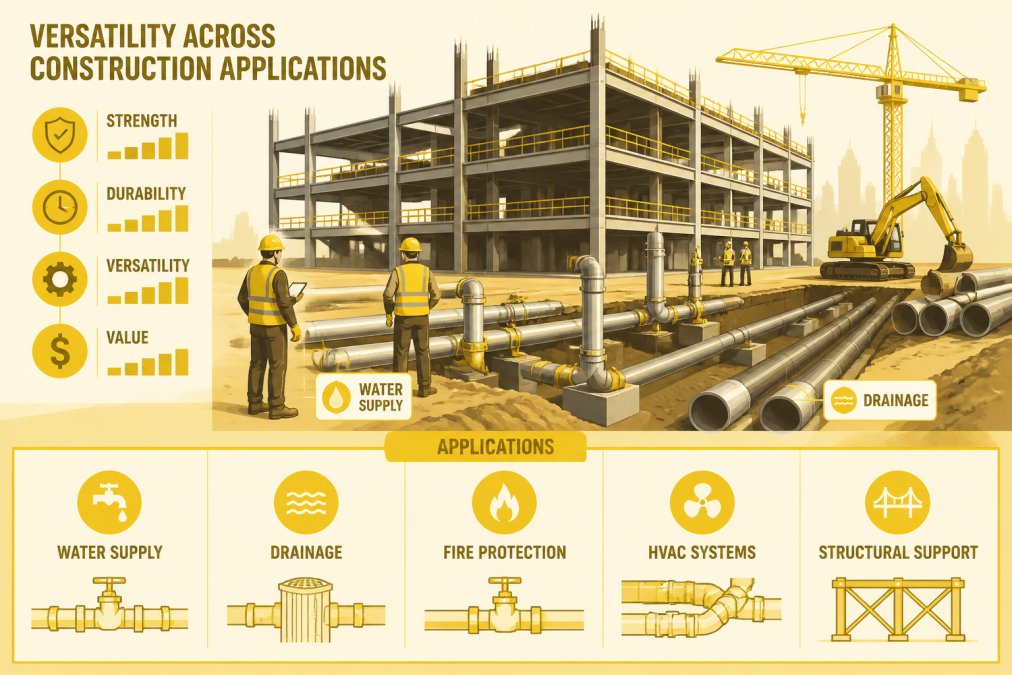
Commercial construction relies on steel pipe for structural frameworks, mechanical systems, and utility distribution. Civil engineering contractors use steel pipe for culverts, drainage systems, and water conveyance. Well drilling contractors depend on steel casing for borehole integrity, with seamless pipe required for directional drilling applications.
Fencing and site development contractors use steel pipe for structural framing because it combines strength with fabrication speed. Agricultural applications from irrigation systems to equipment support structures benefit from steel pipe’s strength and affordability.
This versatility means a single supplier relationship can support multiple project types and applications. Rather than managing separate suppliers for different materials, contractors consolidate their supply chain with a partner who stocks the range of sizes, grades, and products their diverse projects require.
Environmental Impact and Sustainability
Steel is infinitely recyclable. Unlike plastics or composites that degrade through recycling cycles, steel maintains its properties through unlimited reuse. At end-of-life, steel pipe can be melted and reformed into new products without quality degradation.
Modern mills increasingly use electric arc furnaces powered by renewable energy, reducing carbon intensity. Recycled steel content in new pipe typically ranges from 25-60% depending on the mill.
Galvanization extends service life, reducing the environmental cost of replacement and manufacturing emissions associated with producing replacement material. A galvanized pipe lasting 40 years requires fewer replacements than an unprotected pipe requiring coating touch-ups every 10-15 years.
Stainless steel manufacturing is more energy-intensive than carbon steel, but the indefinite service life and zero maintenance requirements offset this initial impact. Over a 50-year lifecycle, stainless steel often delivers lower total environmental impact than carbon steel requiring periodic maintenance and eventual replacement.
For contractors pursuing LEED certification or sustainability goals, steel pipe demonstrates measurable environmental credentials through recyclability, long service life, and increasingly renewable energy-sourced production.
Conclusion: Steel Pipe as Your Construction Foundation
Steel pipe remains the material of choice for construction because it solves the fundamental challenge every contractor faces: delivering reliable performance within budget constraints. Whether designing a multi-story commercial structure, managing drainage infrastructure, drilling wells, or fabricating custom applications, steel pipe provides the structural integrity, durability, and cost-effectiveness that protect your project margins and operational bottom line.
The choice between carbon and stainless steel, the selection of seamless versus welded construction, and the specification of appropriate ASTM standards all flow from your specific application requirements. Understanding these distinctions prevents costly specification errors and ensures your materials perform as designed.
When you’re ready to source steel pipe that meets your exact specifications without supply chain delays or quality surprises, Steel & Pipe Supply delivers the reliability Tampa Bay contractors depend on. We maintain inventory across common grades, sizes, and types, from structural carbon steel to specialized stainless applications, with competitive pricing and delivery timelines that keep your projects on schedule. Our team understands the real constraints contractors face: tight budgets, demanding timelines, and zero tolerance for material failures. Call for a FREE Quote and let’s discuss how our inventory depth and local expertise can strengthen your next project.
Frequently Asked Questions
What are the primary advantages of using steel pipe in construction projects?
Steel pipe excels in construction due to superior tensile strength, structural integrity, and load-bearing capacity. It resists corrosion when properly treated, maintains mechanical properties across temperature extremes, and offers excellent value over the project lifecycle. Steel pipe's ductility allows it to absorb stress without catastrophic failure, making it ideal for high-pressure applications, water supply lines, sewerage systems, and structural frameworks. For contractors, this translates to fewer failures, reduced maintenance costs, and projects that hold their value for decades.
How does carbon steel vs stainless steel pipe affect my material selection?
Carbon steel pipe offers superior tensile strength and cost efficiency, making it the standard choice for most construction and infrastructure projects. Stainless steel pipe provides enhanced corrosion resistance in highly corrosive environments, coastal areas, chemical facilities, or extreme moisture conditions, but costs significantly more. Carbon steel with proper galvanization delivers excellent protection for most applications at a fraction of the price. Evaluate your environment, budget, and long-term maintenance tolerance to choose between them. For Tampa Bay area projects, galvanized carbon steel handles coastal salt exposure effectively while keeping costs competitive.
Do steel pipes need special maintenance, and what does that actually involve?
Maintenance requirements depend on pipe type and environment. Galvanized carbon steel requires periodic inspection for coating damage and touch-up painting in high-corrosion zones, typically every 5-10 years depending on exposure. Stainless steel demands minimal maintenance beyond occasional cleaning. Seamless pipes generally resist fatigue better than welded variants, reducing long-term wear. Regular visual inspections for leaks, pressure testing per ASTM standards, and prompt repair of any coating damage prevent costly failures. Most contractors find that proper initial installation and annual inspections keep steel piping systems performing reliably for 50+ years with minimal intervention.
How do ASTM standards for construction steel pipe protect my project?
ASTM standards define mechanical properties, dimensional tolerances, testing protocols, and material composition for steel pipe. ASTM A106 covers seamless carbon steel pipe for high-temperature service; ASTM A53 covers general-purpose carbon steel; ASTM A312 covers stainless steel. These standards ensure your pipe meets yield strength, tensile strength, and ductility requirements for your specific application. Compliance guarantees that material delivered actually meets your engineer's specifications, preventing dimensional failures, pressure test failures, and catastrophic infrastructure problems. Reputable suppliers like Steel & Pipe Supply verify compliance through certified testing, protecting you from costly rework and liability.
This article was written using GrandRanker