Table of Contents
- Understanding Steel Grade Classification Systems
- ASTM Steel Standards for Fabrication: What Fabricators Need to Know
- The Four Main Types of Steel for Fabrication
- Carbon Steel vs Stainless Steel for Fabrication: Choosing Between Them
- Weldability of Structural Steel Grades: What You Must Know
- Mechanical Properties That Drive Grade Selection
- Common Steel Grades and Their Fabrication Applications
- Service Environment and Temperature Factors
- How to Select the Right Steel Grade for Your Fabrication Project
- Cost-to-Performance Analysis and Supply Chain Considerations
- Post-Fabrication Finishing and Its Impact on Grade Selection
- Regulatory and Certification Compliance
- Common Mistakes in Steel Grade Selection
- Conclusion
Last Updated: August 5, 2026
Understanding Steel Grade Classification Systems
Choosing steel grades for fabrication requires understanding how materials are classified and specified. The classification systems you’ll encounter, AISI, SAE, and ASTM, communicate specific chemical compositions, mechanical properties, and performance characteristics that directly affect your project’s success, cost, and timeline.
These standards exist because fabricators, engineers, and material suppliers need a common language. When you specify "A36 carbon steel" or "304 stainless," everyone involved knows exactly what they’re getting: the composition, strength, weldability, and cost implications are all embedded in that designation.
Understanding how these systems work helps you make faster, smarter decisions about which grade fits your specific application.
AISI and SAE Numbering
The AISI (American Iron and Steel Institute) and SAE (Society of Automotive Engineers) numbering systems use a four-digit code that tells you the alloy composition and approximate carbon content. The first digit indicates the primary alloying element, the second digit shows the percentage of that element, and the last two digits represent the carbon content in hundredths of a percent.
For example, 1045 means plain carbon steel (the "1" prefix) with no significant alloying elements (the "0" in the second position) and 0.45% carbon content. A 4140 alloy steel has molybdenum as the primary alloying element (the "4"), roughly 1% molybdenum (the "1"), and 0.40% carbon (the "40").
This system is straightforward once you decode it and works well for carbon and alloy steels, which is why you’ll see it frequently in fabrication specifications.
ASTM Standards for Fabrication
ASTM International publishes standards that specify material requirements, testing methods, and acceptance criteria. For fabrication work, ASTM standards define not just chemical composition but also the mechanical properties the material must meet, the testing procedures to verify those properties, and dimensional tolerances.
An ASTM specification like A36 or A500 tells you the tensile strength range, yield strength, elongation, and other mechanical properties. ASTM standards are particularly important for structural applications because building codes and engineering specifications often reference them directly.
ASTM Steel Standards for Fabrication: What Fabricators Need to Know
ASTM standards for structural steel define minimum mechanical properties, chemical composition limits, and testing requirements. These standards ensure that materials perform consistently and meet the demands of their intended application. The key insight is that ASTM standards are performance-based: they define what the material must do, not just what it’s made of.
Common ASTM Specifications by Application
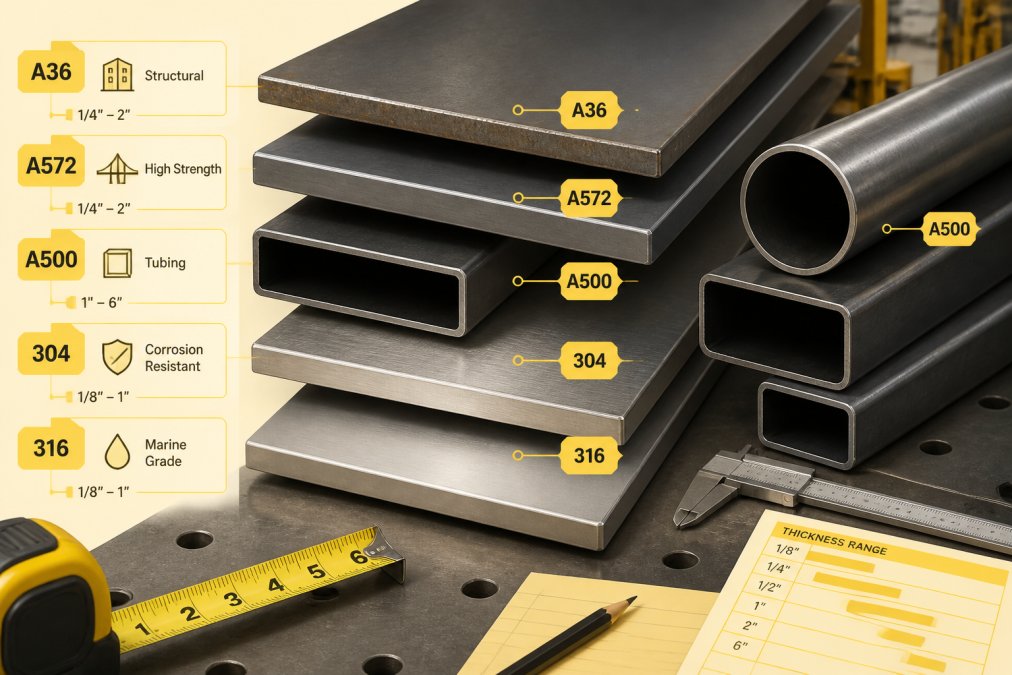
A36 is the workhorse of structural steel. It’s a carbon steel with a yield strength of 36,000 PSI and tensile strength of 58,000-80,000 PSI. It’s easy to weld, widely available, and cost-effective. You’ll find it in buildings, bridges, and general structural work.
A500 is a high-strength, low-alloy (HSLA) structural steel available in several grades (A, B, C) with yield strengths ranging from 42,000 to 65,000 PSI depending on the grade. It offers better strength-to-weight ratio than A36, allowing thinner material while meeting strength requirements.
A572 is another HSLA grade, available in grades 42, 50, 55, and 60 with corresponding minimum yield strengths. It’s stronger than A36 and offers good weldability, commonly used in buildings and bridges.
A588 is a weathering steel that develops a protective oxide layer when exposed to the atmosphere. It’s used where corrosion resistance matters but stainless steel is overkill, costing more than A36 but less than stainless.
For stainless applications, A276 and A479 cover stainless steel bars and shapes, defining multiple grades (303, 304, 316, etc.), each with different corrosion resistance and mechanical properties.
The Four Main Types of Steel for Fabrication
Steel comes in four primary types, each with distinct characteristics.
Carbon Steel
Carbon steel contains primarily iron and carbon, with carbon content ranging from about 0.12% to 2%. It’s the most common and most affordable type of steel. The carbon content directly affects hardness and strength: more carbon means harder, stronger steel but reduced weldability and formability.
Carbon steels are subdivided by carbon content. Low-carbon steels (under 0.30% carbon) are soft and easy to weld and form. Medium-carbon steels (0.30-0.60% carbon) offer better strength with acceptable weldability. High-carbon steels (over 0.60% carbon) are very hard but difficult to weld.
For fabrication work, low to medium-carbon steels are most practical because they balance strength with workability. A36 and A500 grades dominate structural fabrication because they’re affordable, readily available, and easy to work with.
Alloy Steel
Alloy steels contain carbon plus intentional additions of other elements, chromium, molybdenum, nickel, vanadium, or manganese, to achieve specific properties. These alloying elements increase hardenability, strength, and toughness beyond what carbon alone can provide.
A 4140 alloy steel contains molybdenum and chromium and is significantly stronger than carbon steel with excellent hardenability. It’s more expensive than carbon steel and requires more careful welding practices, but when you need strength that carbon steel can’t deliver, alloy steels are the answer.
Stainless Steel
Stainless steels contain chromium (minimum 10.5%) and often nickel, which creates a protective oxide layer that resists corrosion. This makes stainless steel ideal for applications exposed to moisture, chemicals, or corrosive environments.
Austenitic stainless steels (300-series like 304 and 316) are the most common in fabrication because they’re easy to weld and highly corrosion-resistant. They’re significantly more expensive than carbon or alloy steels, so they’re used only when corrosion resistance justifies the cost.
Tool Steel
Tool steels are highly alloyed, hardened steels designed for tools, dies, and punches. They’re extremely hard and wear-resistant but brittle and difficult to weld. Tool steels are rarely used in general fabrication work because their properties are optimized for tooling applications.
Carbon Steel vs Stainless Steel for Fabrication: Choosing Between Them
This is the most common decision point in fabrication projects. Carbon steel is cheaper and easier to work with. Stainless steel resists corrosion but costs significantly more and requires different welding techniques. The choice depends on cost, corrosion environment, and mechanical requirements.
Cost and Availability
Carbon steel is dramatically cheaper than stainless steel. For a given thickness and size, carbon steel plate or tubing costs a fraction of the stainless equivalent. Carbon steel is also more widely available in standard sizes, while stainless steel may require longer lead times or minimum orders.
If your application doesn’t require corrosion resistance, carbon steel is the obvious choice. The cost savings are substantial, and the material performs perfectly in dry, indoor environments.
Corrosion Resistance and Service Environment
If your fabrication is exposed to moisture, salt air, chemicals, or outdoor weather, carbon steel will rust and weaken over time. Stainless steel develops a self-healing oxide layer that prevents rust from forming in the first place.
The specific stainless grade matters. 304 stainless is adequate for most corrosive environments. 316 stainless adds molybdenum for better resistance to chloride corrosion, making it the choice for coastal or salt-spray environments.
Mechanical Properties and Load Requirements
Carbon steel offers good strength at lower cost. A36 has a yield strength of 36,000 PSI. A500 grades reach 42,000 to 65,000 PSI depending on grade. Austenitic stainless steels like 304 have lower yield strength (about 30,000 PSI in annealed condition) than A36. Don’t assume stainless steel is stronger, it’s more corrosion-resistant, but for sheer strength at the lowest cost, carbon steel often wins.
Weldability of Structural Steel Grades: What You Must Know
Weldability determines whether you can join the material without creating weak points, cracks, or brittle zones. Carbon content and alloying elements directly affect weldability.
Carbon Content and Hardenability Effects
Low-carbon steels (under 0.30% carbon) weld easily. The heat from welding doesn’t create hard, brittle zones in the heat-affected zone (HAZ). A36 and low-grade A500 steels are forgiving to weld.
Higher-carbon steels and alloy steels are more prone to hardening during welding. A 4140 alloy steel requires preheating, slower cooling rates, and often post-weld heat treatment to avoid cracking. Austenitic stainless steels like 304 are easy to weld, but they conduct heat differently than carbon steel and are prone to sensitization if cooled slowly.
Heat Treatment Considerations
Some steels benefit from post-weld heat treatment (PWHT) to relieve residual stresses and restore mechanical properties. A36 rarely needs it. Higher-carbon and alloy steels often do.
If your project requires PWHT, that adds cost, time, and equipment requirements. Preheat is also important for thicker sections and higher-carbon steels to slow cooling and prevent cracking. Your welding procedures should specify preheat temperature based on the steel grade and section thickness.
Mechanical Properties That Drive Grade Selection
You’re ultimately choosing a steel grade because you need specific mechanical properties. Understanding what these properties mean prevents over-specification and under-specification.
Tensile Strength and Yield Strength
Tensile strength is the maximum stress the material can withstand before breaking. Yield strength is the stress at which the material begins to deform permanently. For design purposes, yield strength matters more because structures are designed to remain elastic under normal loads.
A36 has a yield strength of 36,000 PSI and tensile strength of 58,000-80,000 PSI. A500 Grade B has 46,000 PSI yield and 60,000 PSI minimum tensile. The higher yield strength of A500 means you can design lighter sections that still meet strength requirements.
Hardness, Ductility, and Impact Toughness
Hardness measures resistance to indentation and wear. Ductility is the ability to deform without breaking. Impact toughness is the ability to absorb energy from sudden loads without cracking.
For structural applications, you typically want adequate strength with good ductility and impact toughness. This prevents sudden, catastrophic failure. Carbon steels deliver this balance well.
Common Steel Grades and Their Fabrication Applications
A36 Carbon Steel
A36 is the default choice for structural steel fabrication. It’s affordable, widely available, easy to weld, and strong enough for most applications. It’s used in buildings, bridges, towers, and any application where cost matters and the loads don’t exceed its capacity.
The main limitation is that it’s not the strongest option. If your design requires lighter sections or higher loads, you’ll need a stronger grade.
A500 High-Strength Low-Alloy Steel
A500 comes in several grades (A, B, C) with yield strengths from 42,000 to 65,000 PSI. The higher strength allows lighter sections, reducing material weight and cost despite the higher per-pound price.
A500 is common in buildings, especially where column or beam weight is a concern. It’s also used in tubular structures where the strength-to-weight ratio is critical.
4140 Alloy Steel
4140 is a molybdenum-chromium alloy steel with high strength and excellent hardenability. It’s used when you need strength beyond what carbon steel provides and when wear resistance matters.
4140 is common in machinery and high-stress components. It requires careful welding with preheat and often post-weld heat treatment. Use it only when the application demands it.
303 and 304 Stainless Steel
303 is a free-machining austenitic stainless steel, easier to machine than 304 but slightly less corrosion-resistant. 304 is the standard corrosion-resistant stainless, used in everything from kitchen equipment to chemical tanks.
These grades are used when corrosion resistance is non-negotiable. 304 is the most common choice because it offers excellent corrosion resistance at reasonable cost.
Service Environment and Temperature Factors
The environment where your fabrication will operate determines whether certain grades are suitable.
High-Temperature Applications
Most structural steels are designed for room-temperature service. At elevated temperatures, mechanical properties degrade. For applications above about 600°F, you need specialty steels designed for high-temperature service. These steels contain elements like molybdenum, vanadium, and chromium that maintain strength at elevated temperatures.
If your application involves sustained elevated temperature, consult the material specifications for the upper temperature limit.
Cryogenic and Low-Temperature Service
At very low temperatures (below -20°F or so), many steels become brittle. Impact toughness drops, and the material can fail suddenly under loads that would be safe at room temperature. Austenitic stainless steels (like 304) remain ductile even at cryogenic temperatures.
If your fabrication will see cryogenic service, specify materials tested and approved for that temperature range.
Corrosive Environments
Corrosive environments, salt spray, industrial atmospheres, chemical exposure, demand corrosion-resistant materials. Carbon steel will rust, requiring expensive coatings and maintenance. Stainless steel resists corrosion naturally.
The specific corrosion environment determines which stainless grade you need. 304 stainless handles most corrosive environments. 316 stainless adds molybdenum for better resistance to chloride corrosion, making it the choice for coastal applications.
How to Select the Right Steel Grade for Your Fabrication Project
Follow these steps to choose a grade that meets your requirements without overspending.
Step 1: Define Load and Stress Requirements
Start with the design loads. What forces will the fabrication experience? Your design engineer should provide a load analysis and specify the required yield strength. This is your starting point. You need a steel grade with yield strength equal to or greater than the design requirement.
Step 2: Assess Service Conditions
Where will the fabrication operate? Indoors, outdoors, coastal, chemical environment, elevated temperature, cryogenic? Service conditions determine whether corrosion resistance and temperature performance matter.
If the fabrication is indoors and dry, carbon steel with paint is fine. If it’s outdoors or in a corrosive environment, stainless steel or weathering steel is necessary.
Step 3: Evaluate Fabrication Constraints
Some grades are easier to work with than others. Low-carbon steels like A36 are forgiving. Higher-carbon and alloy steels require careful welding, preheat, and sometimes post-weld heat treatment.
Consider your shop’s capabilities. If your shop doesn’t have the capability to weld a particular grade properly, choose a grade you can handle reliably.
Step 4: Check Regulatory and Certification Requirements
Building codes, pressure vessel codes, and industry standards often specify which grades are acceptable. Check the applicable codes and standards before finalizing your choice.
Step 5: Compare Cost-to-Performance and Availability
Once you’ve narrowed down to grades that meet strength, fabrication, and regulatory requirements, compare cost and availability. Check availability with suppliers, as some grades have long lead times or minimum order quantities.
Cost-to-Performance Analysis and Supply Chain Considerations
The cheapest material per pound rarely delivers the lowest total project cost. Value engineering, the systematic comparison of material choices against performance requirements and total cost, separates profitable shops from those that leave money on the table.
Total Cost of Ownership vs. Unit Price
Pricing for steel products depends on quantity, dates, and delivery. For a coastal structure, however, carbon steel requires repainting every 5-7 years at significant cost over a 30-year lifespan. Stainless steel requires only passivation (a one-time cost) and minimal maintenance. Over 30 years, stainless steel’s total cost of ownership is often lower than carbon steel with coatings.
Calculate lifecycle cost, not just purchase price. Include material, fabrication labor, surface finishing, transportation, installation, and expected maintenance over the asset’s life.
Supply Chain Availability and Lead Times
Material availability directly impacts project schedule and cost. Common grades like A36 and A500 Grade B in standard sizes are typically stocked and available within 1-2 weeks. Specialty grades, non-standard sizes, or large orders can require 4-12 weeks or longer.
Fabricators who lock in material early avoid rush charges and schedule delays. If your project is on a tight schedule, choose grades with proven local availability or order specialty materials 3-4 months in advance.
Balancing Material Grade with Fabrication Capability
A higher-strength grade that requires preheat, post-weld heat treatment, or specialized welding procedures may cost more in labor than the material savings justify. A36 can be welded by any competent welder with standard equipment. A 4140 alloy steel requires controlled preheat (typically 300-400°F), slow cooling, and often PWHT at 1,100-1,200°F. If your shop doesn’t have PWHT capability, you must send the fabrication to a heat-treat facility, adding time and cost.
The practical choice is often the highest-strength grade you can fabricate reliably in-house.
Value Engineering Decision Framework
When multiple grades meet the design specification:
-
Calculate material cost difference. What’s the per-pound premium for the higher-grade option? Multiply by total weight.
-
Estimate fabrication labor impact. Does the higher grade require preheat, PWHT, or specialized procedures? If it requires outsourced services, get quotes.
-
Assess weight reduction potential. If the higher grade allows thinner sections, calculate the weight savings and labor/transportation cost reduction.
-
Factor in surface finishing. Carbon steel requires painting (cost: $1-$3 per square foot, recurring every 5-10 years). Stainless requires passivation (cost: $0.50-$1.50 per square foot, one-time).
-
Calculate total project cost. Sum material, fabrication, finishing, and transportation. Compare options on total cost.
Most fabricators find that A36 is optimal for routine structural work, A500 wins when weight or section size matters, and stainless is justified only when corrosion resistance eliminates maintenance costs.
Post-Fabrication Finishing and Its Impact on Grade Selection
How you finish the fabrication after welding and machining affects material performance and longevity.
Surface Finish Requirements
Carbon steel requires protection from corrosion. Painting, galvanizing, or powder coating all work, but they add cost and maintenance. Stainless steel requires minimal finishing, a simple passivation removes iron contamination and enhances the natural corrosion resistance.
If your design includes finishing, account for its cost and schedule.
Machinability and Formability Considerations
Some grades machine better than others. 303 stainless is a free-machining grade designed for easy machining. 304 stainless machines harder and slower. Carbon steels generally machine well.
If your fabrication requires extensive machining, choose a grade that machines efficiently. Low-carbon steels are highly formable. Higher-carbon steels are less formable and more prone to cracking during forming operations.
Regulatory and Certification Compliance
Using an unapproved material grade can result in failed inspections, project delays, and costly rework. Understanding which codes apply to your project and which grades they approve is essential.
Building Codes and Structural Steel Standards
Building codes in the United States are based on the International Building Code (IBC), adopted and sometimes modified by individual states and municipalities. The IBC references ASTM standards for structural steel. Specifically, IBC Section 2205 requires that structural steel conform to ASTM A36, ASTM A500, ASTM A572, or other ASTM standards listed in the code.
This means that for a building project, your engineer must specify an ASTM grade that appears in the IBC. A36 and A500 are universally approved. A588 (weathering steel) is approved but with restrictions. A 4140 alloy steel is not listed in the IBC for structural applications and would require special approval.
Always verify code approval before ordering material.
ASME Pressure Vessel Code
If your fabrication is a pressure vessel (any vessel designed to hold gas or liquid under pressure above 15 PSI), it must comply with the ASME Boiler and Pressure Vessel Code (BPVC). This code is far more restrictive than building codes.
ASME Section VIII lists approved materials in Section II, Part D. A36 is approved. A500 is approved. A572 is approved. However, the approval is conditional on thickness, temperature, and pressure rating. Moreover, ASME requires that the fabricator hold an ASME "U" stamp (for unfired pressure vessels) or "S" stamp (for boilers), which means the shop must be certified and inspected by an ASME-authorized inspector.
For pressure vessel work, always consult the ASME code before specifying material.
AWS Welding Standards
The American Welding Society (AWS) publishes standards for welding procedures, welder qualification, and inspection. AWS D1.1 (Structural Welding Code, Steel) specifies which materials can be welded, what preheat and interpass temperatures are required, and what inspection methods apply.
For most structural grades (A36, A500, A572), AWS D1.1 provides clear guidance. For higher-carbon or alloy steels, the requirements become more stringent. If your welding procedure doesn’t follow AWS requirements, the welds can be rejected during inspection.
Industry-Specific Standards
Beyond building codes, specific industries have their own standards:
Aerospace: Structures and components for aircraft must comply with military specifications (MIL-SPEC) or commercial aerospace standards. These standards are far more restrictive than building codes and often require specific heat treatments, certifications, and traceability.
Oil and Gas: Pipelines and pressure equipment must comply with ASME B31.8 (gas pipelines) or B31.3 (process piping). Material traceability is critical.
Food and Beverage: Equipment that contacts food must comply with FDA regulations and often use 304 or 316 stainless steel. Carbon steel is not approved.
Marine and Offshore: Structures in saltwater environments must comply with standards like the American Bureau of Shipping (ABS) or Det Norske Veritas (DNV). Standard A36 is not suitable; you need corrosion-resistant grades.
If your project falls into any of these categories, identify the applicable standard early and verify that your material choice complies.
Material Certification and Traceability
For regulated applications (pressure vessels, aerospace, oil and gas), material certification is mandatory. The mill must provide a Mill Test Report (MTR) or Certificate of Conformance (CoC) that documents the actual chemical composition and mechanical properties of the steel you received.
For routine structural work, material certification is typically not required, but it’s good practice to request it. Traceability means you can identify which mill heat produced the material you used. For regulated work, this is mandatory.
Navigating Code Approval for Non-Standard Grades
If your design requires a grade not listed in the applicable code, you have options:
-
Engineer’s Exception: Your engineer can request a code variance from the building department, providing engineering justification for the non-standard grade.
-
Equivalency Approval: Some codes allow a material not explicitly listed if it can be shown to be equivalent in performance to an an approved material.
-
Substitute an Approved Grade: Often, the simplest solution is to redesign using an approved grade. If A36 is too weak, move to A500 or A572, both of which are universally approved.
-
Consult Early: Before finalizing your design, confirm with the building department or code official which grades are acceptable.
Most fabricators find that sticking to universally approved grades (A36, A500, A572, 304 stainless) eliminates approval headaches.
Documentation and Inspection
For any regulated application, maintain complete documentation: the design specification, the material certification, the welding procedures and inspection reports, and the final inspection sign-off. This documentation proves compliance and protects you if questions arise later.
Inspection is part of the compliance process. For pressure vessels, an ASME inspector must witness critical steps and sign off on the final product. Plan for inspection time in your schedule and budget.
Common Mistakes in Steel Grade Selection
Choosing based on price alone. The cheapest material isn’t always the best value. A slightly more expensive grade that performs better or requires less fabrication work often saves money overall.
Assuming stainless is stronger. Stainless steels like 304 have lower yield strength than A36. Choose based on actual mechanical properties.
Ignoring weldability. High-carbon and alloy steels require careful welding. If your shop can’t weld them properly, choose a grade you can handle reliably.
Overlooking service conditions. Carbon steel rusts in corrosive environments. Choosing carbon steel for coastal applications guarantees maintenance problems.
Exceeding temperature limits. Using standard carbon steel in high-temperature service causes it to lose strength and fail. Know the temperature limits of your chosen grade.
Neglecting regulatory requirements. Codes and standards specify acceptable materials. Using an unapproved grade results in failed inspections and rework.
Underestimating lead times. Specialty grades and large orders take time to source. Order early or choose readily available grades.
Choosing the right steel grade for fabrication is a systematic process based on load requirements, service conditions, fabrication capabilities, and regulatory compliance. Start with the design specification, assess your service environment, evaluate your fabrication constraints, and verify regulatory approval. Then compare cost and performance to make the best choice for your project.
Steel & Pipe Supply stocks the grades you need in the sizes you specify, with competitive pricing and reliable delivery across the Tampa Bay area. We work with contractors, fabricators, and engineers every day to ensure they have the right materials for their projects. When you’re ready to move forward, call for a FREE Quote and let our team help you source the materials that make your project succeed.
Frequently Asked Questions
How do I choose the right steel grade for my fabrication project?
Start by defining your load and stress requirements, then assess service conditions such as temperature, corrosion exposure, and environmental factors. Evaluate weldability and fabrication constraints specific to your process. Check applicable ASTM standards and regulatory requirements for your application. Finally, compare cost-to-performance ratios and verify supply chain availability with your supplier. A36 carbon steel works for many structural applications, while stainless grades suit corrosive environments and alloy steels handle high-strength demands.
What's the difference between carbon steel and stainless steel for fabrication?
Carbon steel offers lower cost, better machinability, and easier weldability, making it ideal for structural work where corrosion is not a concern. Stainless steel provides superior corrosion resistance through chromium and nickel content, essential for wet, salty, or chemically aggressive environments. Stainless costs more and requires careful heat treatment and specific welding procedures. For Tampa Bay coastal projects, stainless grades like 304 resist salt spray better, while carbon steel A36 suits inland structural work where cost matters most.
What do ASTM standards for fabrication tell me about steel grades?
ASTM standards specify mechanical properties, chemical composition, testing methods, and acceptable tolerances for steel grades. Standards like ASTM A36 (carbon structural steel), A500 (high-strength low-alloy structural tubing), and A992 (structural steel shapes) ensure your material meets minimum tensile strength, yield strength, and ductility requirements. Using ASTM-specified grades protects your fabrication quality and ensures compliance with building codes and engineering specifications. Your supplier should provide mill certificates confirming ASTM compliance for every order.
How does carbon content affect weldability of steel grades?
Higher carbon content increases hardenability and strength but reduces weldability by promoting hard, brittle microstructures in the heat-affected zone during welding. Low-carbon steels like A36 (0.25% max carbon) weld easily without special precautions. Medium-carbon alloy steels like 4140 require preheating and controlled cooling to avoid cracking. Stainless austenitic grades like 304 weld well despite moderate carbon content due to their metallurgical structure. Check the carbon equivalent value in your steel's mill certificate to determine required preheat temperatures and welding procedures.
What's the difference between A36 and A500 structural steel?
A36 is a mild carbon steel with 36 ksi minimum yield strength, offering excellent weldability, machinability, and cost-effectiveness for general structural applications. A500 is a high-strength low-alloy steel with 42-50 ksi yield strength depending on shape and thickness, providing better strength-to-weight ratio and reduced material thickness for equivalent load capacity. A500 costs more but saves weight and material volume on large projects. A36 suits standard beams and plates; A500 works better for hollow structural sections and applications where weight reduction saves money on fabrication or transportation.
What does 4140 steel mean, and when should I use it?
4140 is an AISI/SAE alloy steel designation: 41 indicates chromium-molybdenum alloying elements, and 40 means approximately 0.40% carbon content. This combination delivers high strength (tensile strength around 125 ksi when heat-treated) and excellent toughness, making it ideal for shafts, fasteners, and high-stress components. 4140 requires careful welding with preheat and post-weld heat treatment to avoid brittleness. It costs significantly more than A36 but handles demanding applications where structural integrity under shock loads matters. Use 4140 for well drilling equipment, rotating shafts, or components experiencing cyclic stress.
What factors influence the weldability of different steel grades?
Carbon content, alloy composition, hardenability, and thickness all affect weldability. Low-carbon steels (A36) weld easily; medium-carbon and alloy steels require preheating and controlled cooling. Chromium and molybdenum increase hardenability and cracking risk. Thicker sections need higher preheat temperatures. Austenitic stainless steels (304, 303) weld well but require austenitic filler metals and careful heat input control. Before welding any grade, consult the mill certificate for carbon equivalent calculations and follow AWS (American Welding Society) procedures specific to that steel type. Improper welding of high-hardenability steels causes heat-affected zone cracking and joint failure.
This article was written using GrandRanker