Table of Contents
- Angle Iron vs Tubing for Fabrication: Key Differences
- Structural Strength and Load-Bearing Capacity
- Torsional Strength of Square Tubing vs Angle Iron
- Welding Angle Iron vs Square Tube: Fabrication Differences
- Fabrication Ease and Metalworking Requirements
- Weight-to-Strength Ratio and Efficiency
- Cost Comparison: Angle Iron vs Tubing
- Best Steel for Garage Shop Carts and Custom Builds
- Applications for Angle Iron and Square Tubing in Commercial Work
- Comparison Table: Angle Iron vs Tubing
Angle Iron vs Tubing for Fabrication: Complete Comparison
Last Updated: August 4, 2026
Angle Iron vs Tubing for Fabrication: Key Differences
When contractors and fabricators face the decision of angle iron vs tubing for fabrication, they’re choosing between two fundamentally different structural approaches. At Steel & Pipe Supply, we help builders across the Tampa Bay region make this choice every day, and the answer depends entirely on your project’s specific demands. Angle iron, an L-shaped structural steel product, excels at creating simple frames and support structures. Square tubing, by contrast, offers a hollow rectangular cross-section that delivers superior torsional rigidity and a more finished appearance. Understanding which material serves your fabrication goals requires looking beyond cost and examining how each performs under real-world loads.
The distinction matters more than most fabricators realize. Choosing the wrong material doesn’t just add expense; it can compromise structural integrity or force costly rework mid-project. Both materials have legitimate applications, but they solve different problems.
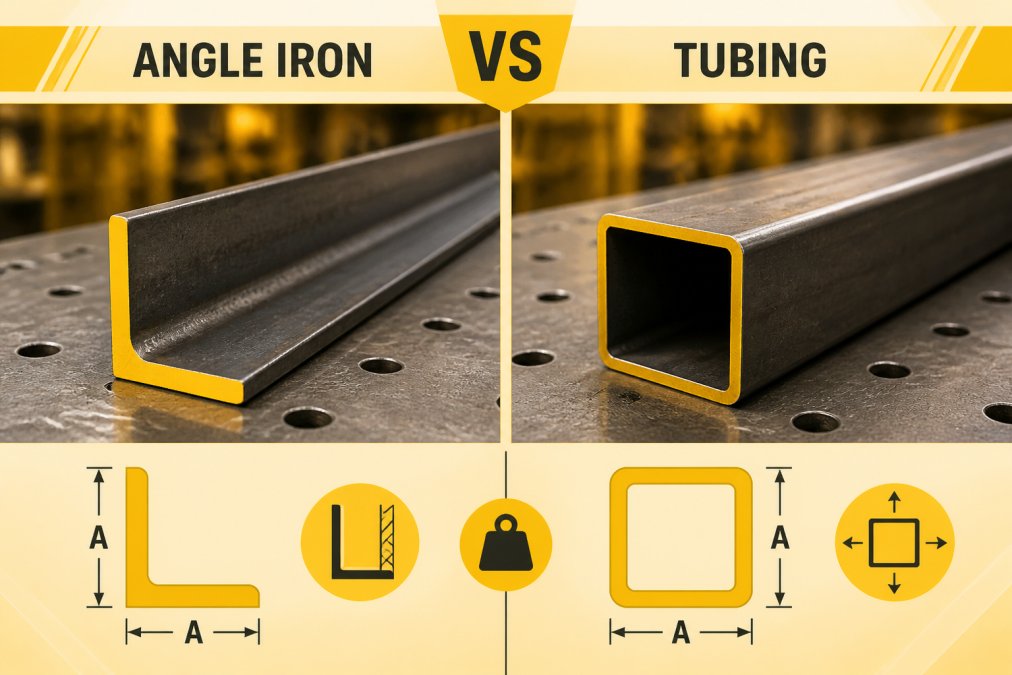
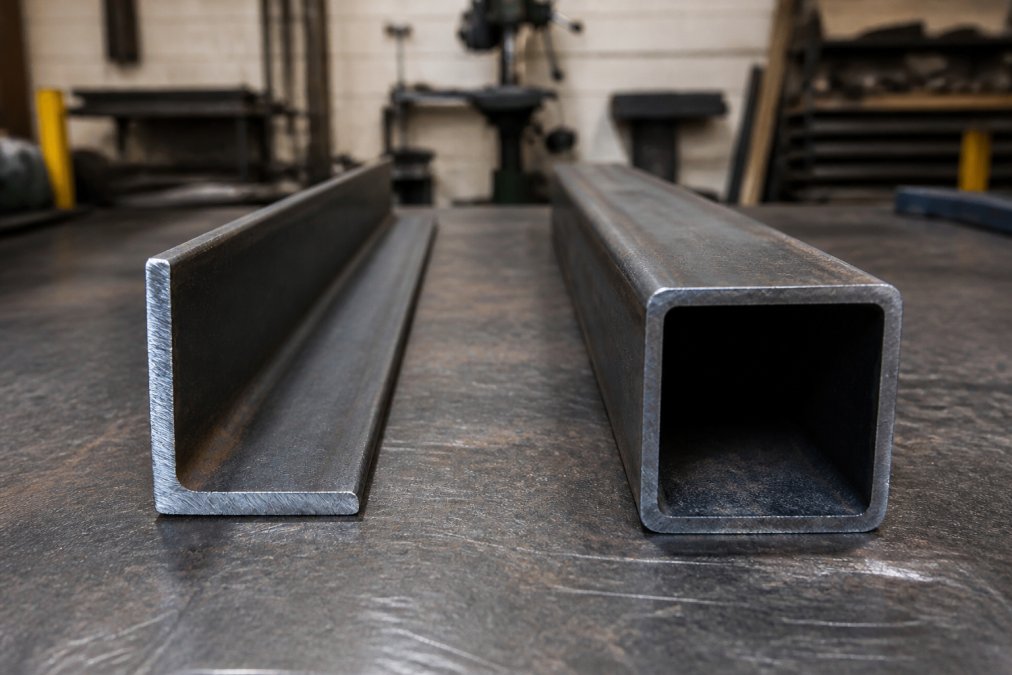
Angle iron consists of two flat plates welded or formed at a 90-degree angle, creating an L-shaped profile. This open design makes it lightweight and economical for basic structural support. The material is straightforward to fabricate, you can bolt, weld, or notch it without special equipment. However, the open profile means it resists torsional (twisting) forces poorly compared to closed-section tubing.
Square tubing is a hollow structural section with four equal sides forming a closed rectangular box. This geometry distributes loads more evenly and resists bending, shear, and torsional stress more effectively than angle iron. The closed profile also provides a cleaner aesthetic, which matters for visible architectural applications. The trade-off: square tubing costs more per pound and requires more precision during fabrication.
The choice between these materials hinges on three factors: the specific loads your structure must handle, the fabrication methods available to you, and whether the finished appearance matters for your project. A garage shop cart might use angle iron for cost efficiency. A structural frame for a commercial building would likely specify square tubing for its superior load-bearing characteristics and torsional stiffness.
Before committing to either material, calculate the actual loads your structure will experience, not just static weight, but dynamic forces, vibration, and any twisting or lateral stress. This single step eliminates most wrong material choices.
Structural Strength and Load-Bearing Capacity
Load-bearing capacity separates these materials more clearly than any other metric. Both angle iron and square tubing can handle significant weight, but they distribute that weight differently across their cross-sections. Understanding moment of inertia and section modulus, two properties that define bending resistance, explains why square tubing outperforms angle iron in most structural applications.
Moment of inertia measures how a cross-section resists bending around an axis. For angle iron vs tubing for fabrication, this difference is dramatic. A 3×3-inch square tube has a moment of inertia roughly 3-4 times higher than a 3×3×1/4-inch angle iron of the same material thickness. This means the tubing resists bending with far less deflection under load. When you apply a perpendicular force to a beam, the tubing deforms less than the angle iron, a critical advantage in precision fabrication or load-bearing structures.
Section modulus relates directly to the bending stress the material can withstand. Higher section modulus means the material can support greater loads without reaching its yield point. Square tubing’s closed profile creates a larger effective cross-section around the neutral axis, yielding higher section modulus values. In practical terms: if an angle iron beam deflects 0.5 inches under a specific load, an equivalent square tube deflects perhaps 0.15 inches.
Compression and tensile strength tell a different story. Both materials are typically made from the same grades of steel, often ASTM A36 or A500, so they have similar tensile strength. The difference isn’t the material’s inherent strength but how that strength is deployed across the cross-section. Angle iron concentrates material along two edges; square tubing distributes it around all four sides. This distribution advantage makes tubing superior for resisting bending, shear, and combined stresses.
For fabrication projects involving significant horizontal or vertical loads, industrial framing, bridge components, machinery support, square tubing is the stronger choice. For simple bolted or welded connections where bending isn’t the primary concern, angle iron often provides adequate strength at lower cost.
Square tubing handles bending loads 3-4 times better than angle iron of equivalent size, making it the structural choice for any application where deflection or precision matters.
Torsional Strength of Square Tubing vs Angle Iron
Torsional rigidity, resistance to twisting, is where square tubing dominates so completely that angle iron becomes impractical for certain applications. When a structure must resist twisting forces, the closed hollow section of square tubing provides inherent advantages that open-profile angle iron simply cannot match.
Torsional stress occurs whenever a force tries to rotate a structural member around its longitudinal axis. Think of a shaft spinning in a machine, a beam resisting wind-induced rotation, or a fabricated frame that experiences rotational loads from offset or eccentric loading. Angle iron, with its open L-shape, offers minimal resistance to this twisting. The material can twist and rotate relatively freely because the cross-section has no closed perimeter to resist the rotational force.
Square tubing, conversely, forms a closed box. The perimeter creates what structural engineers call a torsional constant, a measure of how much twisting resistance the cross-section provides. A 3×3×1/4-inch square tube has a torsional constant roughly 8-10 times higher than a comparable 3×3×1/4-inch angle iron. This means the tubing resists twisting with dramatically less rotation.
For fabrication projects involving machinery mounts, rotating equipment bases, or any structure subjected to eccentric loads that create twisting, square tubing becomes mandatory. Angle iron cannot reliably handle these forces without excessive deflection or failure. This is particularly critical in precision fabrication where dimensional stability matters, even small rotations can throw alignment off and compromise the entire assembly.
How torsional rigidity affects fabrication goes beyond just structural performance. When you’re welding or bolting components together, torsional rigidity determines how stable the assembly remains during and after fabrication. Square tubing holds its geometry better during welding, reducing distortion and the need for corrective work. Angle iron, being more flexible in torsion, can shift and warp more easily, requiring additional bracing or corrective measures during assembly.
Welding Angle Iron vs Square Tube: Fabrication Differences
The welding process reveals fundamental differences between angle iron vs tubing for fabrication. Both materials weld successfully, but the joint preparation, penetration requirements, and final joint strength differ in ways that affect your fabrication timeline and quality outcomes.
Welding penetration and joint quality depend on the geometry of each material. Angle iron presents two flat surfaces that meet at a 90-degree angle. When you prepare an angle iron joint for welding, you typically create a V-groove or bevel on the flat surfaces, allowing the weld to penetrate into the material depth. The open profile makes this relatively straightforward, the welder can access both sides of the joint easily and achieve consistent penetration.
Square tubing presents a closed box geometry. The corners create naturally tight fit-ups, but the closed profile means the welder cannot access the interior of the joint from both sides simultaneously. Full-penetration welds on square tubing require either: (1) careful root pass technique to ensure the weld fuses completely through the wall thickness, or (2) beveling the edges and making multiple passes. This demands higher skill and more time than angle iron welding.
The upside: when square tubing is welded correctly, the joint is inherently stronger. The closed profile contains and directs the weld metal, creating a more uniform heat distribution and stronger fusion. Angle iron joints, while easier to weld, create a structural discontinuity at the open corner, the weld must bridge the gap and create the structural connection, but the open geometry means less material surrounds the joint.
Bolting vs welding considerations shift the comparison again. Angle iron excels with bolted connections. The flat surfaces provide natural bearing areas for bolt heads and washers. You can drill holes easily, and the connection is straightforward to design and install. Many contractors prefer bolted angle iron frames because they’re quick to assemble, easy to modify later, and require no welding equipment on-site.
Square tubing complicates bolted connections. The hollow profile means bolt holes must be drilled carefully to avoid drilling through into empty space inside the tube. Gusset plates or reinforcement is often needed to create adequate bearing area for bolts. However, once these connections are designed properly, they’re extremely strong and reliable.
For fabrication shops with full welding capabilities, square tubing’s superior welded joint strength justifies the extra effort. For field assembly or projects requiring bolted connections, angle iron’s simplicity and speed often make it the practical choice, even if it’s structurally less efficient.
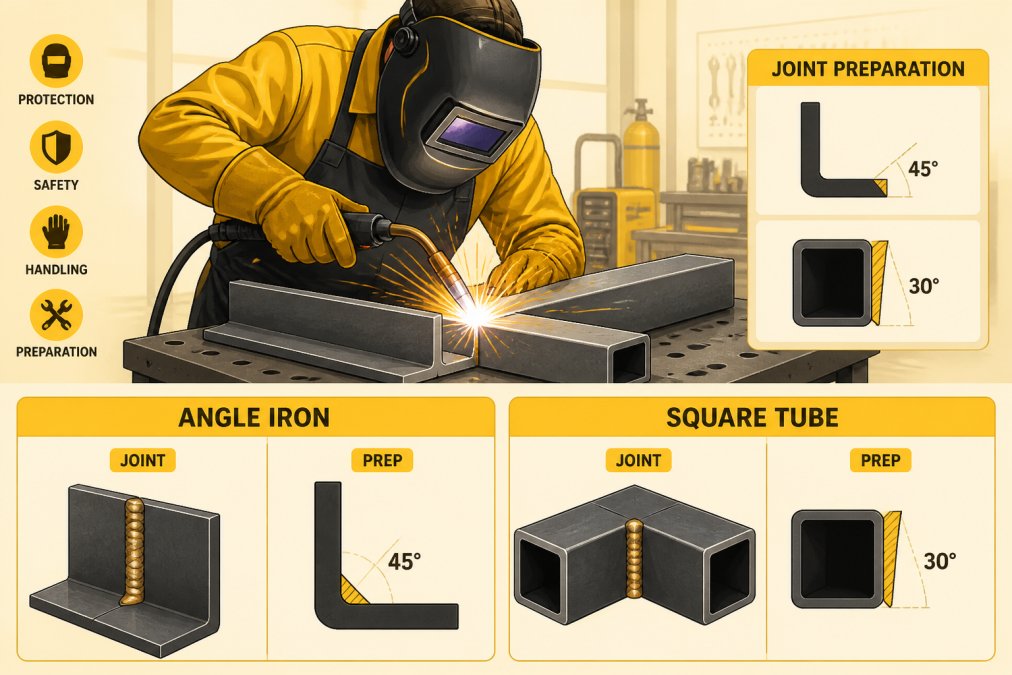
Incomplete penetration on square tubing welds is a common failure point. If you’re welding tubing, invest the time in proper root pass technique or beveling, a weak weld will fail under load, and the failure happens suddenly without warning.
Fabrication Ease and Metalworking Requirements
The day-to-day reality of working with these materials in a fabrication shop reveals practical differences that affect your timeline, labor costs, and equipment needs.
Angle iron is forgiving. You can cut it with a simple bandsaw or angle grinder. Drilling holes is straightforward, you’re drilling into solid material, not navigating the hollow sections of tubing. Bending angle iron requires a hydraulic press or bending brake, but the process is predictable. Notching, cutting away portions of the material to fit joints, is simple: mark the area, drill a pilot hole, and cut it away. Many fabricators can notch angle iron with basic equipment.
Square tubing demands more precision and equipment. Cutting must be square and true, or the hollow sections won’t fit together properly. Drilling requires careful centering to avoid drilling off-center and creating misaligned holes. Bending square tubing requires more force than angle iron and can distort the cross-section if not done carefully. Notching is the biggest challenge: you’re cutting away material from a closed box, and any mistake creates a weak point in the structure.
Corner radius and bending resistance matter more with tubing. Square tubing has rounded corners (typically 1T to 2T, where T is wall thickness). These rounded corners reduce stress concentration but complicate fabrication. When you’re trying to achieve a precise fit-up, those rounded corners mean you can’t achieve a perfectly square corner-to-corner dimension. Angle iron, with its sharp 90-degree angle, offers more dimensional precision.
Bending resistance is higher with tubing. If your fabrication requires bending either material, angle iron bends more easily. Square tubing resists bending in both directions due to its higher moment of inertia. This can be an advantage (better structural performance) or a disadvantage (harder to fabricate if bending is required).
Material thickness and fabrication cost interact in complex ways. Both materials come in various wall thicknesses. Angle iron is typically available in thicknesses from 1/8 inch to 1/2 inch. Square tubing ranges from 1/16 inch (very light) to 5/8 inch (heavy structural). Thicker material costs more per pound but requires less material to achieve equivalent strength.
For angle iron vs tubing for fabrication, the fabrication labor cost often exceeds the material cost. Angle iron’s ease of fabrication means lower labor hours, which can offset its lower structural efficiency. Square tubing’s superior strength means you might need less material by weight, but the fabrication time is longer. The net cost depends on your specific application and labor rates.
Weight-to-Strength Ratio and Efficiency
Efficiency, getting maximum structural performance per unit weight, is where the comparison becomes nuanced. Neither material is universally "better"; each is better for different weight-to-strength priorities.
Square tubing delivers superior strength-to-weight ratio in applications where bending and torsional resistance matter. For a given weight of material, square tubing provides 3-4 times the bending stiffness of angle iron. If your project must minimize weight while maximizing structural performance, think aerospace components, high-performance machinery, or long-span structures, square tubing wins decisively.
However, angle iron offers better cost-to-weight efficiency. You get usable structural performance at lower material cost. For projects where weight isn’t a critical constraint but budget is, angle iron delivers more value per dollar spent.
The practical implication: if you’re fabricating a structure that will be moved frequently (a shop cart, a portable frame), square tubing’s lower weight for equivalent strength justifies the higher material and fabrication cost. If you’re building a permanent, stationary structure where weight doesn’t matter, angle iron’s lower cost per pound makes it the economic choice.
Consider a 10-foot span beam supporting a 1,000-pound distributed load. You could use a 4×4-inch angle iron or a 3×3×1/4-inch square tube. The angle iron weighs more, costs less per pound, but deflects more. The square tube weighs less, costs more per pound, but provides superior performance. The choice depends on whether you’re optimizing for cost, weight, or structural performance.
Cost Comparison: Angle Iron vs Tubing
Material cost and total project cost are not the same thing. Understanding both reveals why the cheapest material choice doesn’t always deliver the lowest project cost.
Material cost and scrap metal value differ between these materials. Angle iron typically costs less per pound than square tubing of equivalent wall thickness. Steel prices fluctuate based on market conditions and material grade, so specific pricing varies. For current pricing on angle iron and square tubing, Steel & Pipe Supply maintains competitive rates and can provide quotes based on your exact specifications and order volume. Contact Steel & Pipe Supply for a free quote reflecting current market conditions.
Scrap metal value is identical, both materials are recycled as structural steel at the same scrap price per pound. However, fabrication waste differs. Angle iron generates less waste during cutting and drilling because the open profile requires fewer corrective cuts. Square tubing, with its closed profile, sometimes requires more material removal to achieve clean joints, increasing scrap waste.
Fabrication labor and time investment often determines total project cost. Angle iron fabrication is faster. Simple cuts, straightforward drilling, and easier notching mean less labor time. A skilled fabricator can produce angle iron structures quickly. Square tubing fabrication takes longer. Every joint requires more careful preparation, welding takes longer to achieve full penetration, and drilling must be more precise.
For a simple bolted frame, angle iron might require 20 labor hours. The same frame in square tubing might require 35 labor hours due to welding complexity and precision requirements. At typical fabrication labor rates, this labor cost difference can exceed the material cost difference, making angle iron the cheaper choice overall.
However, if your project requires fewer pieces due to superior structural efficiency, you need less tubing than angle iron, the labor savings from fewer components might offset the higher per-piece fabrication time. The calculation requires looking at total project cost, not just material or labor in isolation.
Request a complete fabrication quote from Steel & Pipe Supply that includes material, labor, and any finishing or coating costs. Comparing total project cost, not just material price, ensures you’re making the economically optimal choice.
Best Steel for Garage Shop Carts and Custom Builds
For fabricators working on garage projects and custom builds, the material choice often comes down to available tools, skill level, and whether the project will be moved frequently.
When to use angle iron for DIY projects: Angle iron is the right choice if you’re working with basic tools and limited welding experience. A simple angle grinder, a drill press, and a hydraulic press are sufficient to fabricate angle iron structures. You can create functional, reliable frames using bolted connections with no welding required. The open profile makes it forgiving, small imperfections in drilling or cutting don’t compromise the structure as easily as they would with tubing.
Angle iron works well for stationary shop carts, workbenches, and storage racks. These structures don’t move frequently, so weight isn’t a concern. The cost savings are significant, and the fabrication is straightforward enough for someone without professional experience. Many garage fabricators default to angle iron for exactly this reason, it’s accessible and reliable.
When square tubing outperforms angle iron: Square tubing is the better choice if your cart or frame will be moved frequently or if it must support dynamic loads. A mobile tool cart that gets rolled across a concrete floor experiences twisting forces as it navigates corners and obstacles. Square tubing’s superior torsional rigidity means the frame stays square and doesn’t rack or twist. The finished appearance is also superior, square tubing looks more professional and refined than angle iron.
If you have welding equipment and basic fabrication skills, square tubing becomes practical. The extra effort in welding and precision drilling is worthwhile if the structure will be moved frequently or if appearance matters. A custom motorcycle frame, a precision equipment stand, or a mobile fabrication workstation all benefit from square tubing’s structural advantages.
For projects requiring both strength and light weight, a portable welding cart, a collapsible work platform, square tubing is the only practical choice. The weight savings justify the added fabrication complexity.
Applications for Angle Iron and Square Tubing in Commercial Work
Commercial fabrication projects often have specific requirements that make one material clearly superior to the other.
Industrial framing and structural applications where angle iron dominates include simple support structures, bolted frameworks, and temporary or semi-permanent installations. Industrial buildings often use angle iron for roof trusses, floor framing, and equipment supports. The material is economical, the bolted connections are reliable and easy to inspect and maintain, and the open profile allows for easy cable routing, bolt attachment points, and future modifications.
Angle iron is also standard for outdoor structures like billboard frames, antenna mounts, and utility structures. The open profile allows water drainage and air circulation, reducing corrosion concerns. Bolted connections are easier to maintain in outdoor environments than welded joints.
Architectural integration and aesthetic considerations shift the preference to square tubing. Modern buildings often use square tubing for exposed structural elements, columns, beams, and bracing that are visible and part of the architectural design. The clean, finished appearance of square tubing complements contemporary architecture. The closed profile also provides a cleaner aesthetic for interior spaces where exposed structure is an intentional design feature.
Structural steel for parking garages, pedestrian bridges, and commercial building frames increasingly specifies square tubing or other closed sections. The superior structural efficiency means less material is needed, reducing visual bulk. The finished appearance is more refined than angle iron.
Steel & Pipe Supply works with architects and structural engineers across the Tampa Bay region to specify the right materials for commercial projects. Whether your project requires the economy and simplicity of angle iron or the structural efficiency and aesthetic appeal of square tubing, our team can help you select the optimal material and provide competitive pricing on volume orders.
Comparison Table: Angle Iron vs Tubing
| Property | Angle Iron | Square Tubing | Winner for Most Applications |
|---|---|---|---|
| Bending Stiffness | Lower (3-4x less than tubing) | Higher (superior moment of inertia) | Square Tubing |
| Torsional Rigidity | Very Low (open profile) | High (closed box) | Square Tubing |
| Tensile Strength | Similar | Similar | Tie (material-dependent) |
| Welding Complexity | Simple (open profile, easy access) | Complex (closed profile, precision required) | Angle Iron |
| Bolting Simplicity | Excellent (flat surfaces) | Good (requires gussets/reinforcement) | Angle Iron |
| Fabrication Time | Fast (straightforward cuts, drilling) | Slower (precision required) | Angle Iron |
| Weight-to-Strength | Lower (more weight for same strength) | Higher (less weight needed) | Square Tubing |
| Material Cost/lb | Lower | Higher | Angle Iron |
| Aesthetic Appearance | Industrial, utilitarian | Modern, refined | Square Tubing |
| Corrosion Resistance | Good (open profile drains water) | Requires drainage holes | Angle Iron |
| Best for DIY/Garage | Yes (simple tools, bolted) | Requires welding equipment | Angle Iron |
| Best for Load-Bearing | Adequate for simple loads | Superior for heavy loads | Square Tubing |
Choosing between angle iron vs tubing for fabrication requires balancing structural requirements, fabrication capabilities, budget, and project-specific constraints. Angle iron excels at cost-effective, bolted structures where simplicity and accessibility matter. Square tubing delivers superior strength, torsional rigidity, and aesthetic appeal for applications where structural efficiency and finished appearance are priorities.
Steel & Pipe Supply stocks both materials in multiple sizes, grades, and wall thicknesses to support your fabrication projects across the Tampa Bay region. Whether you’re specifying materials for a commercial construction project, outfitting a metal fabrication shop, or building a custom frame in your garage, our team can help you select the right material and provide competitive pricing. Call Steel & Pipe Supply for a free quote and expert guidance on material selection for your next project.
Frequently Asked Questions
Which is stronger: angle iron or square tubing?
Square tubing generally offers superior structural performance due to its hollow cross-section and four load-bearing walls. It provides higher moment of inertia and torsional rigidity compared to angle iron's two-sided design. However, strength depends on wall thickness, material grade, and tensile strength properties. For applications requiring resistance to bending and twisting forces, square tubing typically outperforms equal-weight angle iron. Angle iron excels in applications where simple, direct compression loads are primary. Your choice depends on load direction and fabrication requirements for your specific project.
How does torsional strength of square tubing compare to angle iron?
Square tubing delivers significantly higher torsional rigidity due to its closed, symmetrical hollow structure. This design distributes twisting forces across all four walls, resisting rotational stress more effectively than angle iron's open L-shaped profile. Angle iron experiences torsional weakness because its two flanges cannot resist twisting loads as efficiently. For projects involving rotational forces, machinery mounts, or structural components subject to torsion, square tubing is the superior choice. Angle iron works adequately for applications with primarily bending and compression loads but should not be relied upon for torsional applications in critical structural work.
Is angle iron or tubing cheaper for fabrication projects?
Angle iron typically costs less per pound than square tubing because it uses less material for the same length. However, total project cost depends on fabrication labor, welding requirements, and material efficiency. Square tubing may require fewer pieces or less reinforcement to meet strength specifications, potentially offsetting higher material costs. Scrap metal value also factors in: tubing generates more waste during notching and cutting, while angle iron's simpler geometry produces less scrap. For detailed pricing on both materials in your area, contact Steel & Pipe Supply for a competitive quote based on your exact specifications and project volume.
What's the best steel for garage shop carts and custom fabrication?
Square tubing is the preferred choice for garage shop carts and mobile fabrication tables because it provides superior rigidity, resists twisting when loaded unevenly, and offers clean, professional aesthetics. Its hollow structure reduces overall weight compared to solid angle iron while maintaining strength. Angle iron works for simpler cart designs with straightforward loading patterns, but square tubing prevents wobbling and sagging under dynamic loads. For carts with wheels and frequent movement, square tubing's torsional strength prevents frame distortion. Consider wall thickness of 1/8 inch or greater for durability. Galvanized steel resists corrosion in workshop environments better than raw steel.
When should I choose angle iron over square tubing for welding fabrication?
Choose angle iron when your project involves simple, direct compression or bending loads without significant torsional forces. Angle iron is easier to weld for beginners due to its open profile, allowing better access and visibility for welding penetration. It's more economical for straightforward bracing, shelving, and structural support where load direction is predictable. Angle iron also works well for architectural applications where the visible L-shaped profile adds aesthetic appeal. However, if your design requires bolted connections rather than welding, or if you need superior bending resistance, square tubing becomes more practical. Evaluate both material thickness and fabrication method before deciding.
This article was written using GrandRanker